
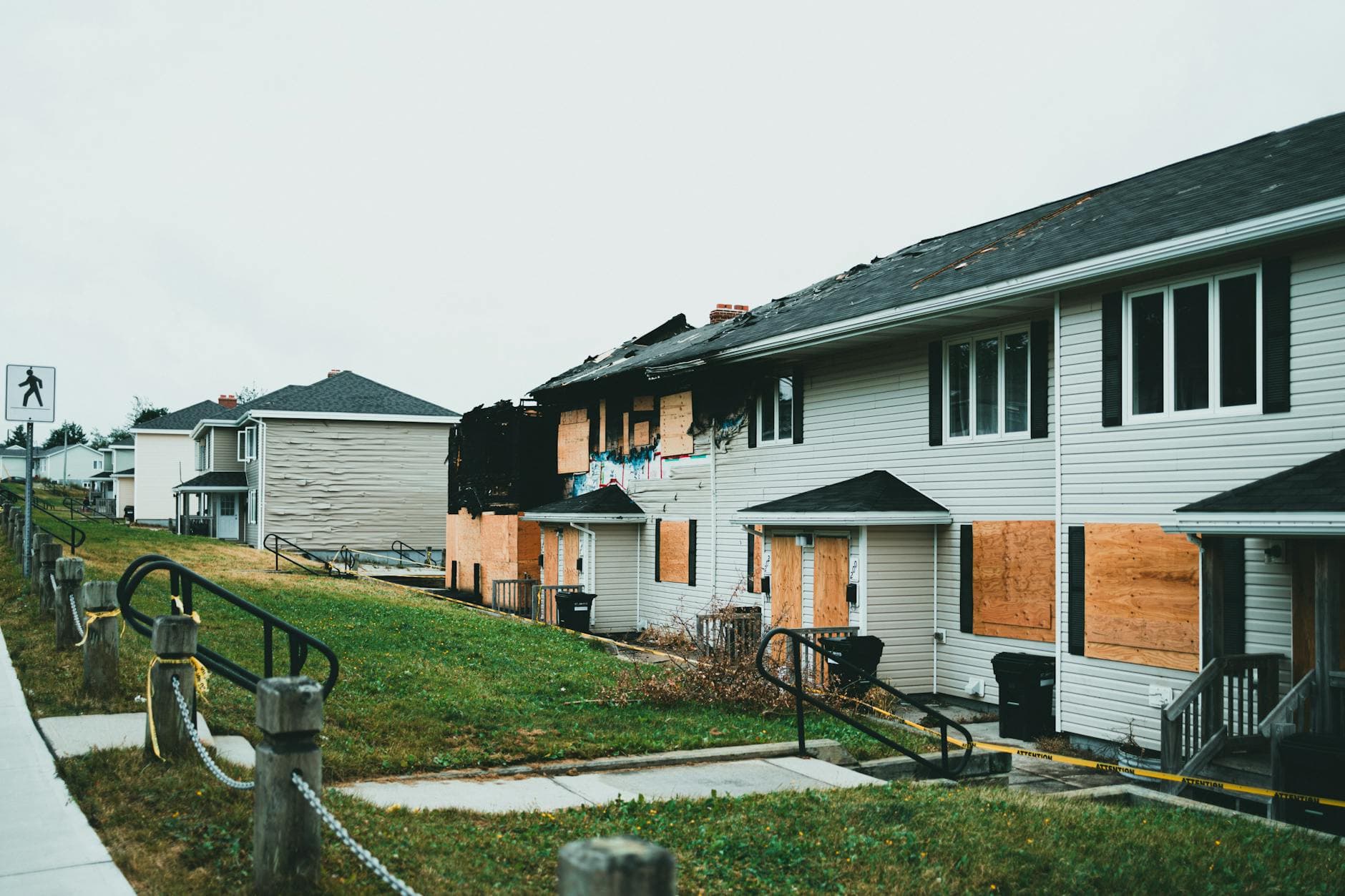
The Insurance Claim That Almost Bankrupted a 20-Unit Building
March 17, 2026
|By Tanner Sherman, Managing Broker
The most expensive line item in your operating budget isn't the one you're paying. It's the one you will pay when the wrong thing happens and your policy doesn't cover it.
A few years ago, I was consulting on a 20-unit apartment building in the Omaha metro when a hailstorm came through and tore the roof apart. Shingles everywhere. Water pouring into six units on the top floor. Ceilings damaged. Carpet soaked. Two tenants displaced.
The owner called his insurance company the next morning feeling confident. He had insurance. That's what it's for. Everything would be fine.
It wasn't fine. The claim process nearly sank the building.
The Policy Nobody Read
Here's what the owner didn't know. His insurance policy covered the building at Actual Cash Value (ACV), not Replacement Cost Value (RCV). He didn't choose ACV on purpose. When his agent set up the policy, ACV was the default. The premium was lower, the owner liked the number, and nobody explained the difference.
The difference is this.
Replacement Cost Value pays you what it costs to repair or replace the damaged property with new materials of similar kind and quality. If a new roof costs $85,000, RCV pays $85,000 (minus your deductible).
Actual Cash Value pays you the replacement cost minus depreciation-actually-works). The roof was 14 years old on a 25-year shingle. The insurance company depreciated the roof by 56%, which meant the ACV payout was roughly $37,000 on a roof that would cost $85,000 to replace.
The owner was staring at a $48,000 gap between what insurance paid and what the roof actually cost. On top of that, the interior damage to the six affected units ran another $42,000 in repairs. Drywall, carpet, paint, remediation for the water damage. Insurance covered some of it, but every line item was depreciated because the whole policy was ACV.
Total insurance payout: approximately $54,000. Total repair cost: approximately $127,000. Gap: $73,000 out of pocket.
On a 20-unit building with an NOI of roughly $90,000 per year, a $73,000 surprise expense wipes out nearly an entire year of net income. That isn't a setback. That's a crisis.
The Vacancy Spiral
But the roof was only the first problem. The real damage was the vacancy cascade.
Six units were directly impacted by water damage. Two tenants left immediately. They broke their leases, and honestly, you can't blame them. Their ceilings were falling in. Three more tenants withheld rent while repairs were underway, citing habitability issues. The sixth tenant stayed but demanded and received a substantial rent credit.
The repairs took 11 weeks. Not because the contractor was slow, but because the building needed a full roof replacement before interior work could begin. You can't fix drywall while rain is still coming through.
During those 11 weeks, the two vacated units generated $0. The three tenants withholding rent represented another $3,300 per month in lost revenue. The rent credit on the sixth unit was $450 per month.
Total lost rent during the repair period: approximately $14,800.
Here's the part that really hurt. The owner's policy didn't include Loss of Rents coverage. This is an endorsement you can add that reimburses you for rental income lost when units are uninhabitable due to a covered peril. It typically costs $200 to $500 per year on a 20-unit building. The owner didn't have it because nobody told him it existed.
Add it up. $73,000 in uninsured repair costs. $14,800 in lost rent. $87,800 total hit. On a building that was generating $90,000 in NOI.
The owner ended up taking a personal loan to cover the gap. He considered selling but the building was in too rough a shape to show well. It took him two years to financially recover.
The Three Coverage Gaps That Kill Buildings
That story is extreme but the underlying mistakes are common. I see these three gaps in almost every insurance policy review I do.
Gap 1: ACV vs. RCV
If your policy says Actual Cash Value anywhere on the declarations page, you're underinsured. Full stop. On a newer building this might not matter much because depreciation is minimal. On anything older than 10 years, the difference between ACV and RCV can be 40% to 60% of the claim.
RCV policies cost more. Usually 15% to 25% more in annual premium. On a 20-unit building, that might be the difference between $14,000 and $17,000 per year. An extra $3,000 annually to protect against a $73,000 gap is the easiest math in real estate.
When you get your policy renewal, look at the declarations page. Find the valuation basis. If it says ACV, call your agent that day.
Gap 2: Loss of Rents (Business Income)
Loss of Rents coverage, sometimes called Business Income coverage on commercial policies, reimburses you for the rental income you would have collected from units that are uninhabitable due to a covered loss.
If a fire damages four units and they're offline for three months, Loss of Rents pays you the rental income those four units would have generated during the repair period. At $1,100 per unit, that's $13,200 in protected income.
The cost of this endorsement is negligible relative to the risk. We're talking $200 to $500 per year on most multifamily policies. I have never seen a building owner regret having it. I have seen several regret not having it.
Make sure the coverage period is long enough. Some policies cap Loss of Rents at 6 months. Some go to 12 months. If you have a major structural event like a fire or tornado, repairs can easily exceed 6 months. Get the 12-month coverage. The premium difference is usually under $100 per year.
Gap 3: Underinsurance (The Coinsurance Trap)
This one is sneaky. Most commercial property policies include a coinsurance clause, typically 80% or 90%. It means you must insure the building for at least 80% or 90% of its replacement cost. If you don't, the insurance company penalizes you on every claim, even small ones.
Here's how it works. Say your building has a replacement cost of $2,000,000. Your policy has an 80% coinsurance requirement, which means you need to insure for at least $1,600,000. But you set the coverage limit at $1,200,000 because the premium was lower.
You file a $100,000 claim for fire damage. The insurance company applies the coinsurance penalty:
($1,200,000 / $1,600,000) x $100,000 = $75,000 payout.
You just lost $25,000 on the claim because your coverage limit was too low. Not because the damage wasn't covered. Not because you had a high deductible. Because you underinsured the building and the coinsurance clause kicked in.
This happens more often than you would think. Construction costs have risen 30% to 40% in the last five years in many markets. A building you insured for $1.5 million in 2020 might cost $2.1 million to replace today. If you haven't updated your coverage limit, you're sitting in a coinsurance trap and don't even know it.
The Annual Insurance Audit
Every building in our portfolio gets an annual insurance audit. Here's what that looks like.
Review the declarations page. Verify RCV valuation, coverage limits, deductible amounts, Loss of Rents endorsement, and coinsurance percentage.
Update replacement cost estimates. Construction costs change. We get updated estimates annually and adjust coverage limits accordingly. This protects against the coinsurance trap.
Shop the policy. Insurance carriers aren't all created equal. We get quotes from at least three carriers every year. Last year, we moved two buildings to a different carrier and saved $4,100 in combined annual premium with equal or better coverage.
Review endorsements. Water backup coverage. Ordinance or law coverage (pays for code upgrades required during repairs). Umbrella/excess liability. Equipment breakdown. Each building has different risk exposure and needs a tailored endorsement package.
Check the deductible. A higher deductible lowers your premium but increases your out-of-pocket on every claim. On a 20-unit building, I want a deductible that's high enough to keep the premium reasonable but low enough that a single claim doesn't create a cash flow crisis. For most of our buildings, that sweet spot is $2,500 to $5,000.
The Premium Isn't the Price
Here's the mental shift every building owner needs to make. Your insurance premium isn't the cost of insurance. It's the cost of transferring risk.
The real cost of insurance is what you pay when something goes wrong and your policy doesn't cover it. That $3,000 you saved by choosing ACV over RCV? It cost you $73,000 when the hailstorm hit. The $400 you saved by skipping Loss of Rents? It cost you $14,800 in unrecoverable income.
Cheap insurance is the most expensive mistake in real estate.
I review insurance on every building I manage or consult on. Not because I like reading policy documents. Because a single underinsured claim can undo years of operational excellence. You can do everything right on rent collection, maintenance, tenant retention, and expense management, and one storm with the wrong policy wipes it all out.
Don't let that happen to your building. Pull your declarations page today. Not tomorrow. Not next renewal. Today. If you see ACV instead of RCV, if you don't see Loss of Rents coverage, if your coverage limit hasn't been updated since 2020, you're one storm away from the same phone call that nearly sank this building.
The premium increase to fix all three gaps is probably less than one month's rent on a single unit. The cost of not fixing them is everything.
If you own rental properties and you're not sure they're hitting their ceiling, let's talk. Reach out at Tanner@TopTierInvestmentFirm.com.
Tanner Sherman is the Principal and Managing Broker of Top Tier Investment Firm in Omaha, Nebraska. He co-hosts the Freedom Fighter Podcast with Ryan of Avara Investments.
Related Reading
The Annual Budget Process for a Multifamily Building
Best Real Estate Investments for Dermatologists (Beyond the Practice Building)
Should Your Shop Own Its Real Estate? A Shop Owner's Guide to Buying the Building
Plastic Surgeons: Own the Building Your Practice Operates In
Related Insights
All Insights →Home Price to Rent Ratio by City: The One Number That Screens a Market Before You Ever Call a Broker
Home price to rent ratio by city, explained with real thresholds. Model it yourself, then talk to a broker who gets DS/ML buyers.
Asset ManagementReal Estate Investing for Content Creators: Turning Algorithm Income Into Owned Assets
Real estate investing for content creators and influencers. How creators should invest their money in assets an algorithm can't touch.
Asset ManagementDealer or Investor? The IRS Test Every Dealer Principal Needs to Know Before Buying Real Estate
Dealer or investor classification real estate tax: how the IRS test applies to dealer principals buying property beyond the dealership lot.
Want to talk strategy?
30 minutes. No pitch. Just your numbers.
Bring a deal, a portfolio, or a question. We will walk through the numbers together and tell you straight what we see.